
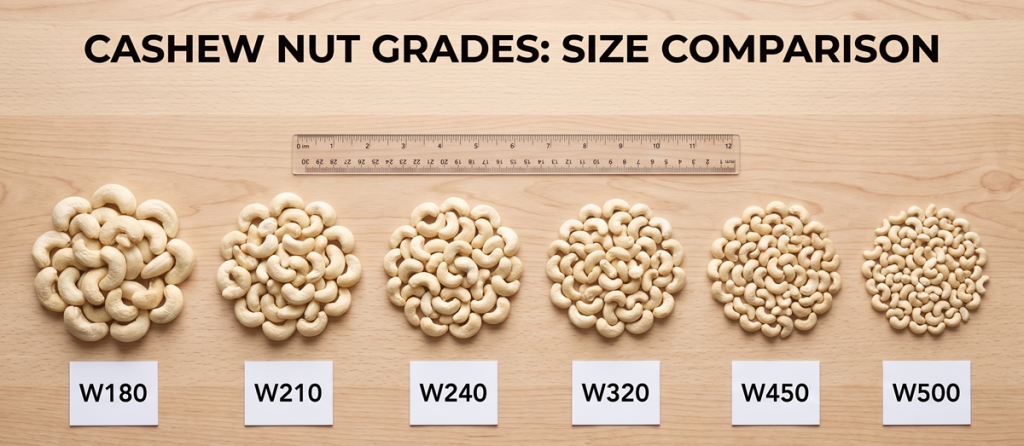
CASHEW NUT GRADES W180, W210, W240, W320, W450, W500
Cashew kernels are strictly graded and evaluated for quality based on rigorous national and international standards. The grading process primarily relies on three fundamental criteria: Shape (degree of breakage), Size, and Color.
1. Grading by Size (Applicable to whole 'W' kernels)
Size is determined by counting the number of cashew kernels per pound (approximately 454 grams). A lower number indicates larger, more expensive kernels.
- W180: Extra-large size (approx. 170 – 180 kernels/pound). This is the most premium grade, featuring large, beautiful white kernels, often dubbed the “King of Cashew.”
- W210 (Jumbo): Large size (approx. 200 – 210 kernels/pound).
- W240: Medium-large size (approx. 220 – 240 kernels/pound).
- W320: Medium size (approx. 300 – 320 kernels/pound) – This is the most popular and commonly traded grade on the market.
- W450, W500: Small and very small sizes.
2. Grading by Shape (Wholeness of the kernel)
- W (Wholes): Whole cashew kernels, unbroken.
- S (Splits): Cashew kernels split naturally lengthwise into two halves.
- B (Butts): Cashew kernels broken crosswise, often retaining the curved end.
- P (Pieces): Cashew kernels broken into multiple pieces. This group is further subdivided into:
– LP (Large Pieces): Large fragments.
– SP (Small Pieces): Small fragments.
– BB (Baby Bits): Extremely small, fine fragments (often passing through small sieves).
3. Grading by Color
- White (W): Kernels are white or pale ivory. This represents the highest quality in terms of flavor and appearance.
- Scorched (S): Kernels have a slight yellowish or pale greyish tint due to slight overheating during roasting/processing.
- Second Scorched (SS): Kernels have a deeper yellowish or light brown tint, darker than ‘S’ grade.
- Dessert (D) / Blemish (B): Kernels that are speckled, spotted, insect-damaged, or heavily darkened. Variations include LB (Light Blemish) and DB (Dark Blemish).
Example: If you see the cashew code WW320 (White Wholes 320), it signifies that the cashews are white in color, whole, and the size corresponds to approximately 320 kernels per pound.
4. Common Cashew Quality Standards
To guarantee quality, consistency, and food safety for global export, manufacturers must adhere to stringent sets of standards. Below are the most prominent ones:
- AFI Standard (The Association of Food Industries – USA): This is the most critical and widely adopted standard worldwide for the commercial trade of cashew kernels (common versions include AFI 2012, AFI 2016). The AFI standard meticulously regulates parameters, abbreviations, color, permissible percentages of broken pieces, damaged kernels, and surface defect criteria to standardize products entering the US and international markets.
- TCVN 4850:2010 Standard (Vietnam): This is the Vietnamese National Standard applicable to processed cashew kernels from the cashew tree. This set of standards outlines specific technical requirements including shape, size, cleanliness, color, packaging methods, and food safety criteria to meet both domestic consumption and export demands.
- Other International Standards:
– UNECE: A standard specifically applied to the stringent European Union (EU) market.
– CENTA: The standard of the Combined Edible Nut Trade Association (UK).
– CEPCI: Grading specifications from the Cashew Export Promotion Council of India.
– ASEAN Standard 20:2011: The standard for the Association of Southeast Asian Nations.